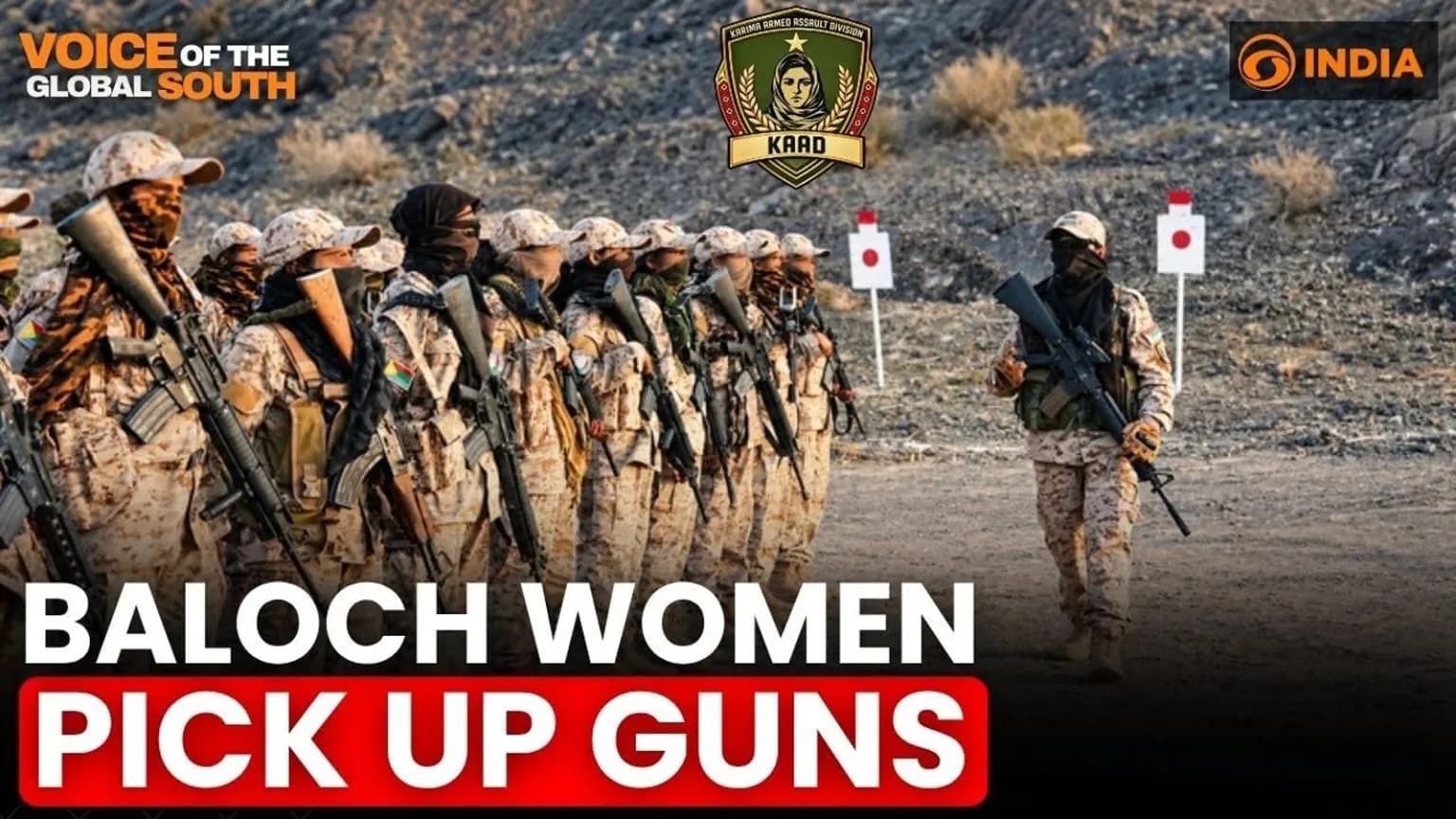
Pakistan’s decades-old Balochistan insurgency has taken a radical, unexpected turn. More women are stepping onto the frontlines than before. A newly-formed, all-woman combat unit has launched its maiden attack on Pakistani security forces. For Pakistan’s Army Chief, Gen. Asim Munir, this adds a dangerous new layer to an escalating security crisis. Especially for billions of dollars in Chinese infrastructure projects.
http://youtu.be/AEVRMfoKCnI
The Balochistan Liberation Front has unveiled what it calls the Karima Armed Assault Division – an all-woman, armed-unit operating on the frontlines of a decades-long conflict in Pakistan’s restive Balochistan province. It released a video showing its women-fighters carrying out their maiden armed operation against Pakistani security personnel. The footage showed women dressed in military-style camouflage uniforms, carrying assault weapons and undergoing what the group describes as a rigorous combat and tactical training.
On 22nd September, they opened fire on a three-vehicle Quick Reaction Force convoy near the area of Jusak, in Turbat. The military convoy was travelling along a vital transit route associated with the China-Pakistan Economic Corridor, widely known as CPEC. A second operation was carried out in Mangchar area of Kalat district on 25th September. The woman-fighters set up highway blockades, took tactical positions and conducted snap checks on civilian and transit vehicles moving through the region. In all, the B.L.F. claimed that nine Pakistani military personnel were killed and many were wounded, although the claims could not be independently verified.
The Karima Armed Assault Division represents a formal, separately-named, structurally-independent, armed-wing for women within the B.L.F. hierarchy. It has been named after Karima Baloch, a former chairperson of the Baloch Students Organisation Azad. In 2016, she was named by the B.B.C. in its annual list of 100 inspirational women. She fled Pakistan to seek refuge abroad only to be found dead in Toronto, Canada, in December 2020. An article published by a U.S.-based magazine called New Lines called Karima Baloch’s death a turning point for gender roles in the Baloch independence movement. By naming a combat unit after her, the B.L.F. is tying political legacy to armed militancy.
The B.L.F. is one of the oldest and main armed groups operating in Balochistan. It was formed in 1964 in Syria, inspired by Arab nationalism. It went underground and later resurfaced in the early 2000s. For years, it had avoided suicide operations and systematic recruitment of female fighters. This stance distinguished it from the Balochistan Liberation Army, another Baloch nationalist group.
The Balochistan Liberation Army is younger; it was formed only in 2000. It is the most active, ethno-nationalist militant group in the region. It is also the first Baloch group to carry out suicide attacks. By 2011, it had formed the Majeed Brigade – an elite, suicide-squad for specialised operations. In 2025, the B.L.A. officially announced Shaynaz Baloch as the commander of its women’s wing. Seen in that context, the Karima Armed Assault Division of the B.L.F. is modelled on the dedicated women’s wing of the B.L.A.
An inflection point was reached in 2022 when the B.L.A.’s Majeed Brigade began using women for suicide attacks. In April that year, Shari Baloch, a teacher and a mother of two, detonated an explosive-vest outside the entrance of the University of Karachi’s Confucius Institute. The attack targeted a minibus, killing three Chinese academics and their Pakistani driver.
It was the first time a woman had carried out such a suicide attack in the region. Since then, a number of such attacks have taken place:
— In June 2023, Sumaiya Qalandrani Baloch targeted a Pakistani paramilitary and security-forces convoy in Turbat;
— in August 2024, Mahal Baloch, a 23-year-old student of law from Gwadar, executed a vehicle-borne suicide car-bombing targeting a military base in Bela area of Lasbela district;
— in March 2025, Mahikhan Baloch targeted a paramilitary convoy in Mughalzai area of Kalat district; and
— in January 2026, Asifa Mengal attacked a compound of the Pakistani spy agency, Inter-Services Intelligence, in Nushki district while Hawa Baloch took part in an armed siege in Gwadar.
Unlike the Balochistan Liberation Army, the Balochistan Liberation Front had refrained from suicide attacks for years. However, in 2025, it changed its strategy. Zareena Rafiq was the first female suicide-bomber fielded by the B.L.F. She drove a vehicle laden with explosives into a paramilitary complex in Nokundi – an area heavily tied to Chinese and other foreign economic interests.
An Islamabad-based think-tank, called the Pakistan Institute for Conflict and Security Studies, said that the formation of the Karima Armed Assault Division is part of a wider tactical and political shift inside the B.L.F. The pattern matches a broader trend across Baloch armed groups, in which women’s participation has moved from exceptional propaganda cases towards institutionalised roles. A New Delhi-based website called Security Risks Asia said that the Karima Armed Assault Division is intended to be both an operational formation and an ideological project. The B.L.F. portrays its female members as predominantly highly-educated and politically-conscious, using their participation to present the insurgency as an intellectual and political movement rather than simply an armed or tribal rebellion.
This evolution adds a complex layer to the security challenge facing both Islamabad and Beijing. Balochistan is the absolute geographic heart of the China-Pakistan Economic Corridor. Major highways, deep-water ports, and massive infrastructure projects link the resource-rich province directly from Gwadar to China. Geographically, Balochistan is Pakistan’s largest province by area, accounting for nearly 50 per cent of the country’s territory. It is also the most resource-rich, holding vast reserves of natural gas, copper and gold. Yet, despite this immense wealth potential, the region has suffered from decades of severe underdevelopment, weak public services and political alienation. A May 2020 study by the Pakistan Institute of Development Economics found that nearly 41 per cent of households in Balochistan lived below the poverty line. According to a Canadian journalist, Mary Link, unlike the human-rights abuses against other ethnic minorities, such as the Uyghurs in China or Yazidis in Iraq and Syria, the world knows little of the plight of the Baloch.
Many Baloch communities openly accuse the Pakistani Government and Military of unequal resource distribution and economic neglect. It is this long-standing grievance that has fuelled the decades-old insurgency, with separatist groups demanding greater autonomy or complete independence. Balochistan has been in the throes of this insurgency for the last many decades. The current, 21st-century wave of Baloch insurgency is said to be the fifth, and is considered to be larger and more lethal than the previous four, which took place in 1948, 1958, 1968 and 1973. Unlike the earlier waves, which revolved around demands for political autonomy, equitable resource-sharing and proportional representation for the Baloch in Pakistan’s mainstream politics, the current wave espouses separatism and does not believe in a negotiated resolution to the conflict.
Whether the Karima Armed Assault Division develops into a sustained operational force remains to be seen. However, its formal introduction proves that the Baloch conflict is continuing to evolve and the weaponisation of its political movement is reaching unprecedented territory.