
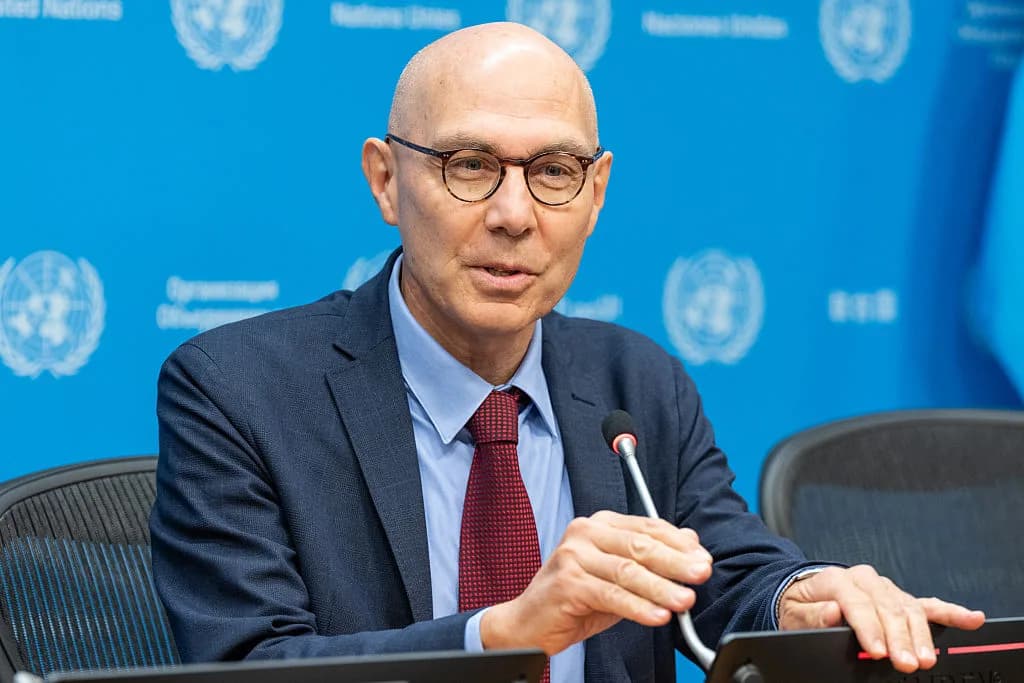
UN High Commissioner for Human Rights Volker Turk has called for the immediate release of former Pakistan Prime Minister Imran Khan, expressing concern over reports of his deteriorating health and prolonged detention.
In an interview with CNN’s Christiane Amanpour, Turk called for Khan’s proper medical treatment and urged both the government and opposition to take steps to ease political tensions.
“I call for Imran Khan’s release. I call for his proper treatment, and I actually call for de-escalation. We need to diffuse the political tensions that are around this case, which means that a confidence-building measure between the opposition and the government could be his immediate release,” Turk said.
Earlier, Imran Khan’s son, Kasim Khan, appealed to the international community to intervene over his father’s detention, accusing Pakistan’s military leadership, headed by Army Chief Asim Munir, of killings, abductions and torture.
In a post on X, Kasim expressed concern over his father’s safety and urged the international community to act before any harm came to the former prime minister.
“Munir and his regime will not listen to reason. They kill, abduct and torture at will. It is time the world acted, before they kill my father, the rightful, democratically elected leader of Pakistan,” he wrote.
Amnesty International has also raised concerns over Khan’s detention conditions, stating that he has not been allowed to meet his family since December 2025, except for two meetings with his sister in August 2026. The organisation further said he had not been permitted to speak to his sons over the telephone since March 2026.
The human rights organisation expressed concern over the 74-year-old former prime minister’s reported solitary confinement and increasing isolation from human contact, warning that the conditions could adversely affect his physical and mental health.
It also highlighted reports of serious blood pressure complications and alleged that Pakistani authorities had denied him access to independent medical professionals despite an August 2026 Supreme Court order directing that he be shifted to a private hospital.
Amnesty International also raised concerns over the health of Khan’s wife, Bushra Bibi, saying she was suffering from an eye ailment that could potentially lead to vision loss and had not received adequate medical treatment.
On November 16, Khan reportedly issued an urgent open letter from Adiala Jail addressed to Pakistan’s top judges, seeking immediate medical attention and implementation of pending court orders. He claimed to be facing a potentially life-threatening medical emergency and warned that his wife risked permanent blindness while in detention.
The former prime minister also alleged that jail authorities had kept him in “torturous solitary confinement for up to twenty-two hours a day” since December 20, 2025, when the verdict in the Toshakhana (Bvlgari) case was announced.
He further claimed that his confinement had restricted family visits, telephone conversations with his sons, access to reading materials and meetings with his legal counsel.
Published: Friday, 20 November 2026 | 12:04 PM IST