
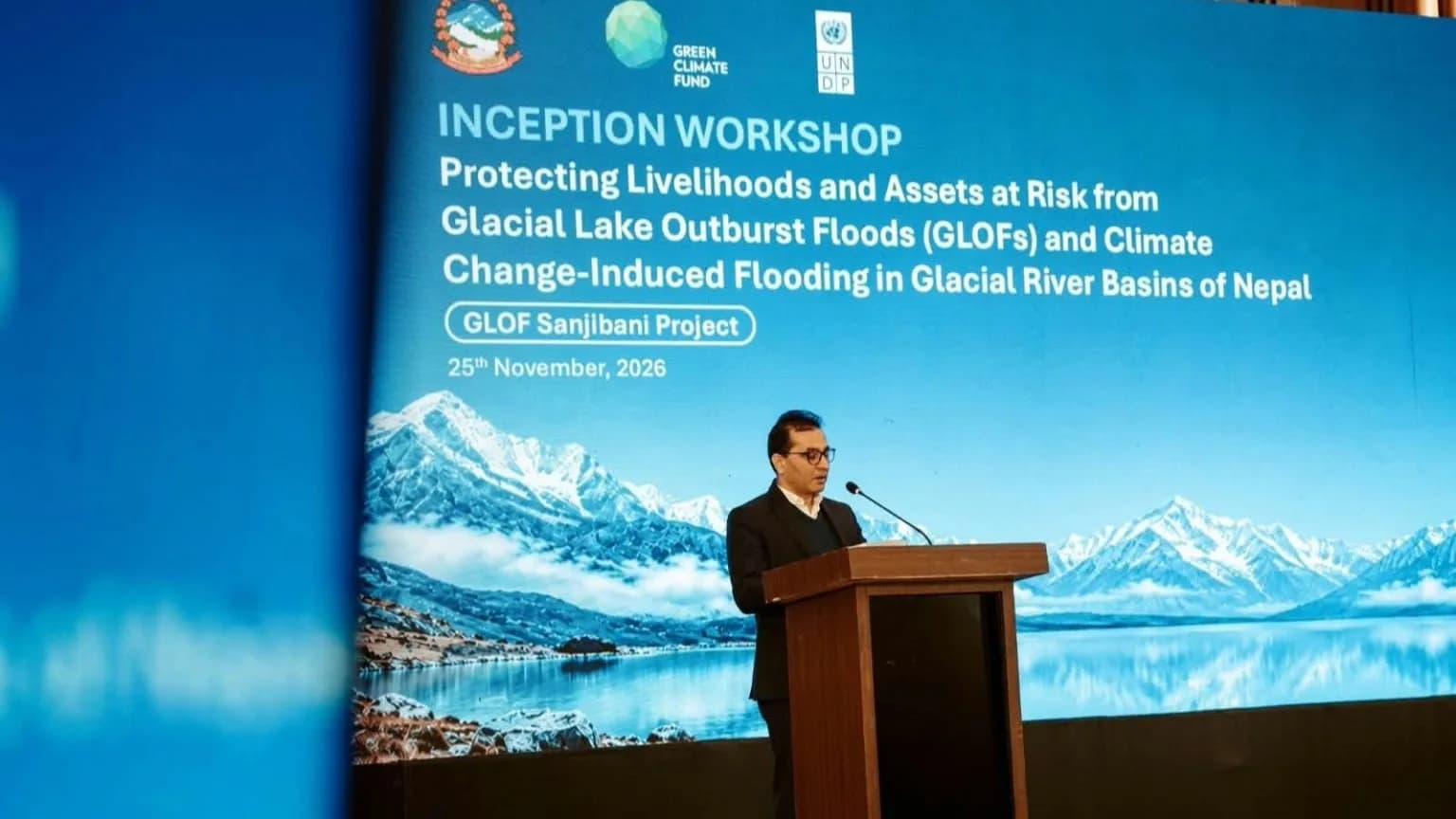
The Government of Nepal, in collaboration with the United Nations Development Programme (UNDP), launched a US$49.94 million project on November 25 to reduce the risk of floods caused by the sudden bursting of glacial lakes in the Himalayan region.
The project, named GLOF Sanjivani, was formally introduced at a national inception workshop held in Kathmandu. It aims to protect people living in mountain areas and communities downstream that could be affected by such floods.
A major part of the project involves reducing water levels in four high-altitude glacial lakes. These are Thulagi Lake in Manang, Lumding Tsho and Hongu 2 in Solukhumbu, and Lower Barun Lake in Sankhuwasabha.
Under the plan, water levels in Thulagi, Lumding Tsho and Lower Barun will be reduced by three metres each, while the level in Hongu 2 will be lowered by one metre.
Glacial lake floods occur when large amounts of water stored in lakes formed by melting glaciers suddenly flow downstream. Such floods can damage villages, roads, bridges, hydropower projects and other infrastructure.
The project will also improve monitoring of glaciers and glacial lakes, strengthen weather and flood warning systems and introduce measures to protect vulnerable communities and infrastructure.
It is expected to directly benefit more than 3.85 lakh people and improve the safety of nearly 20 lakh others living in downstream river basins.
The project will run from 2026 to 2033. It includes a grant of US$36.16 million from the Green Climate Fund, US$11.32 million from the Government of Nepal, US$2.14 million from UNDP and US$0.32 million from private-sector partners.
Published: Thursday, 26 November 2026 | 2:27 PM IST