
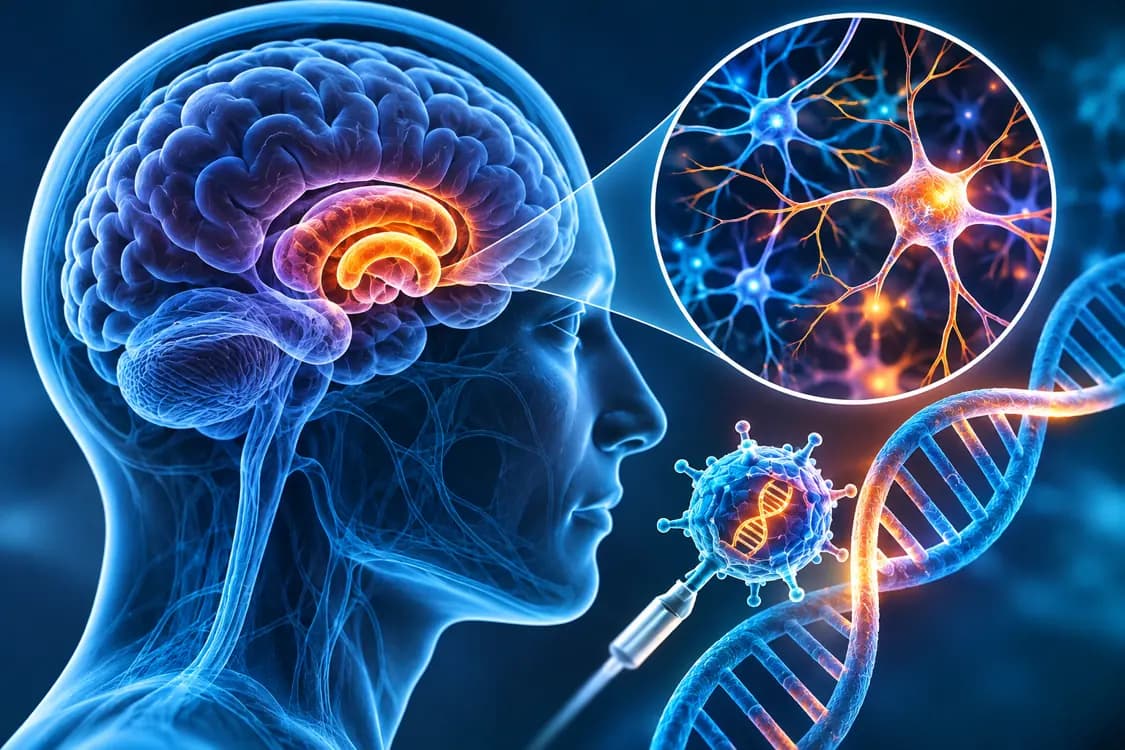
Scientists have successfully developed a “smarter” version of an existing gene therapy that reduces the hallmark tremors associated with Parkinson’s disease.
Described in one of a package of 26 studies published in the Cell Press family of journals, the new approach was both more effective in animal models and less invasive — therefore more scalable — than current treatment approaches given to humans, researchers said.
Parkinson’s disease, Huntington’s disease, schizophrenia, bipolar disorder, and addiction are crippling conditions with genetic and molecular ties to the basal ganglia — an interconnected set of structures deep within the brain critical for movement, habit formation, decision making, and emotion.
The team, involving hundreds of scientists across nine countries and more than 50 institutions including the Allen Institute and others in the US and Europe, have produced the most detailed and comprehensive multi-species cellular atlas of the basal ganglia to date.
The atlas is an expansive library of brain cell types and datasets across human, macaque, marmoset, and mouse that the researchers said serves as a powerful tool for understanding brain cells and what they do.
Using technologies that measure gene expression in individual cells, the researchers profiled 25.5 million of them from the brains of humans (21.0 million cells), rhesus and cynomolgus macaques (3.0 million cells), and marmosets (1.5 million cells).
The massive body of work represents the first major working model of a standardised, cross-species brain cell reference atlas, they said.
“Disease conditions are always cell-type-specific, so in order to understand what’s really going on in the brain, you have to have an accurate cell-type list and examine individual gene expression in each cell type,” Hongkui Zeng, executive vice president and director of Brain Science at the Allen Institute, said.
“I’m very excited about the package because it’s a demonstration of the power of team science and open science, people working together and creating a common standard for the field and using that to amplify the impact that we can make,” Zeng said.
In another study, the researchers discovered a new type of brain cell, STR D2 SMYD2-HTR7, tied to schizophrenia and bipolar disorder.
“Schizophrenia has been associated with the striatum, but it has been difficult to define which neurons are vulnerable,” author Nelson Johansen, assistant investigator at the Allen Institute, said.
“Our study revealed a rare neuron type expressing the serotonin receptor HTR7 that was not found in previous studies, which carries elevated schizophrenia risk. This atlas narrows the genetic disease signal down to a specific population that researchers can now explore,” Johansen said.
Another study led by researchers at the University of California, San Francisco revealed key genetic changes in specific cell types of the basal ganglia that could play a role in autism. The new insight has the potential to lead to new treatments and a deeper understanding of this neurological condition, they said.
Published: Friday, 13 November 2026 | 5:02 PM IST