
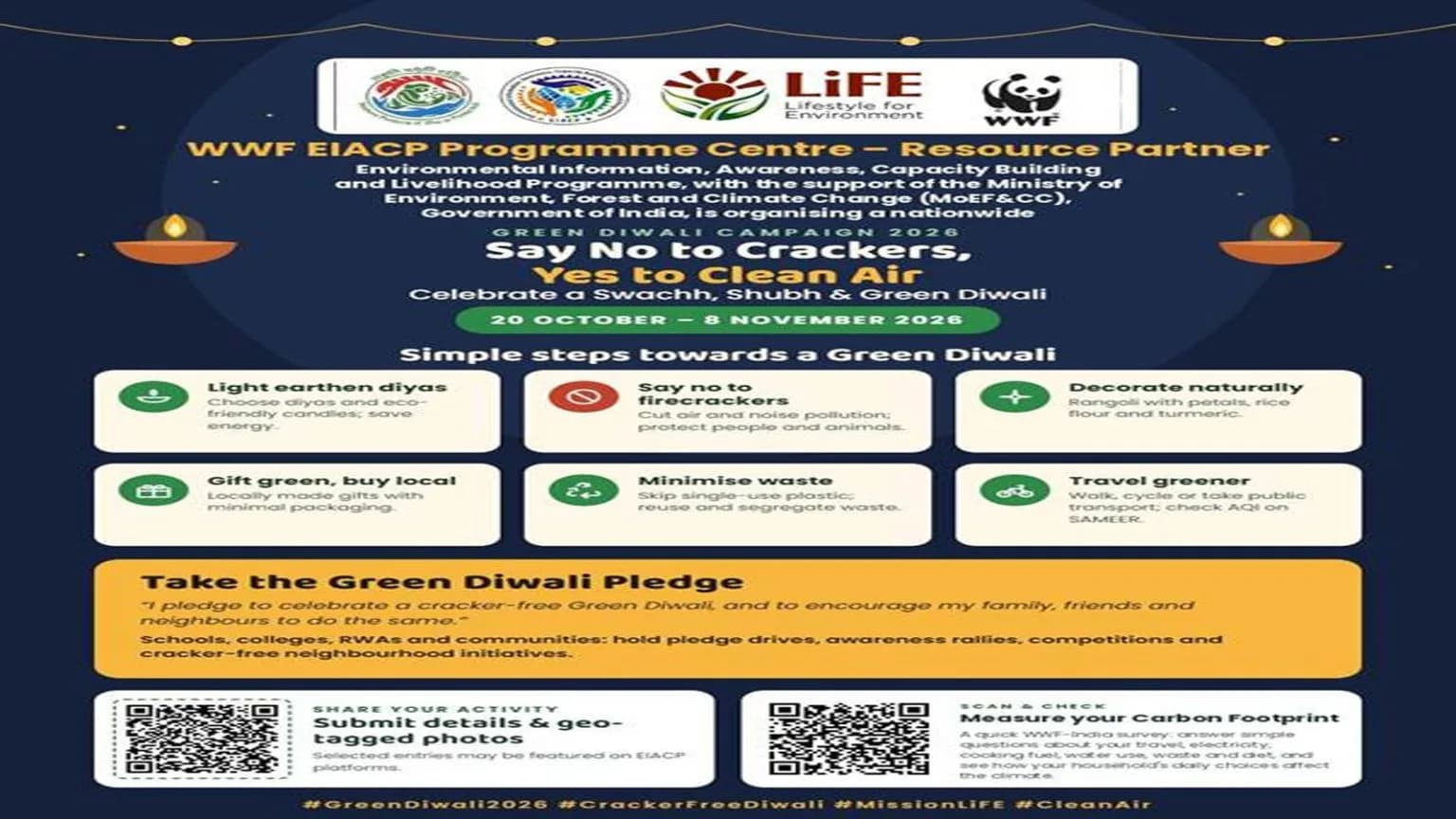
WWF-India’s EIACP (Environmental Information, Awareness, Capacity Building and Livelihood Programme) Programme Centre – Resource Partner has launched a nationwide Green Diwali campaign, urging citizens to avoid firecrackers and adopt environmentally responsible ways of celebrating the festival.
The campaign, supported by the Union Ministry of Environment, Forest and Climate Change (MoEFCC), will run from October 20 to November 8. It will reach schools, colleges, resident welfare associations and local communities, with a special focus on the 130 cities covered under the National Clean Air Programme.
Aligned with Mission LiFE, or Lifestyle for Environment, the initiative encourages citizens to take a Green Diwali Pledge to avoid firecrackers and persuade family members and neighbours to do the same.
The pledge also promotes the use of diyas and energy-efficient lighting, avoidance of single-use plastic, waste segregation and the purchase of local products. Educational institutions and community groups have been encouraged to organise pledge drives during assemblies, classes, rallies and community meetings.
WWF-India has also invited citizens to complete its online Carbon Footprint Survey to understand the environmental impact of their daily activities and consumption patterns and identify more sustainable habits.
Participating institutions, community groups and individuals can submit details of their activities through an online form. Submissions should include the organisation’s name and location, the activity and date, the number of people who took the pledge, geo-tagged photographs and a brief report.
Published: Tuesday, 20 October 2026 | 5:50 PM IST