
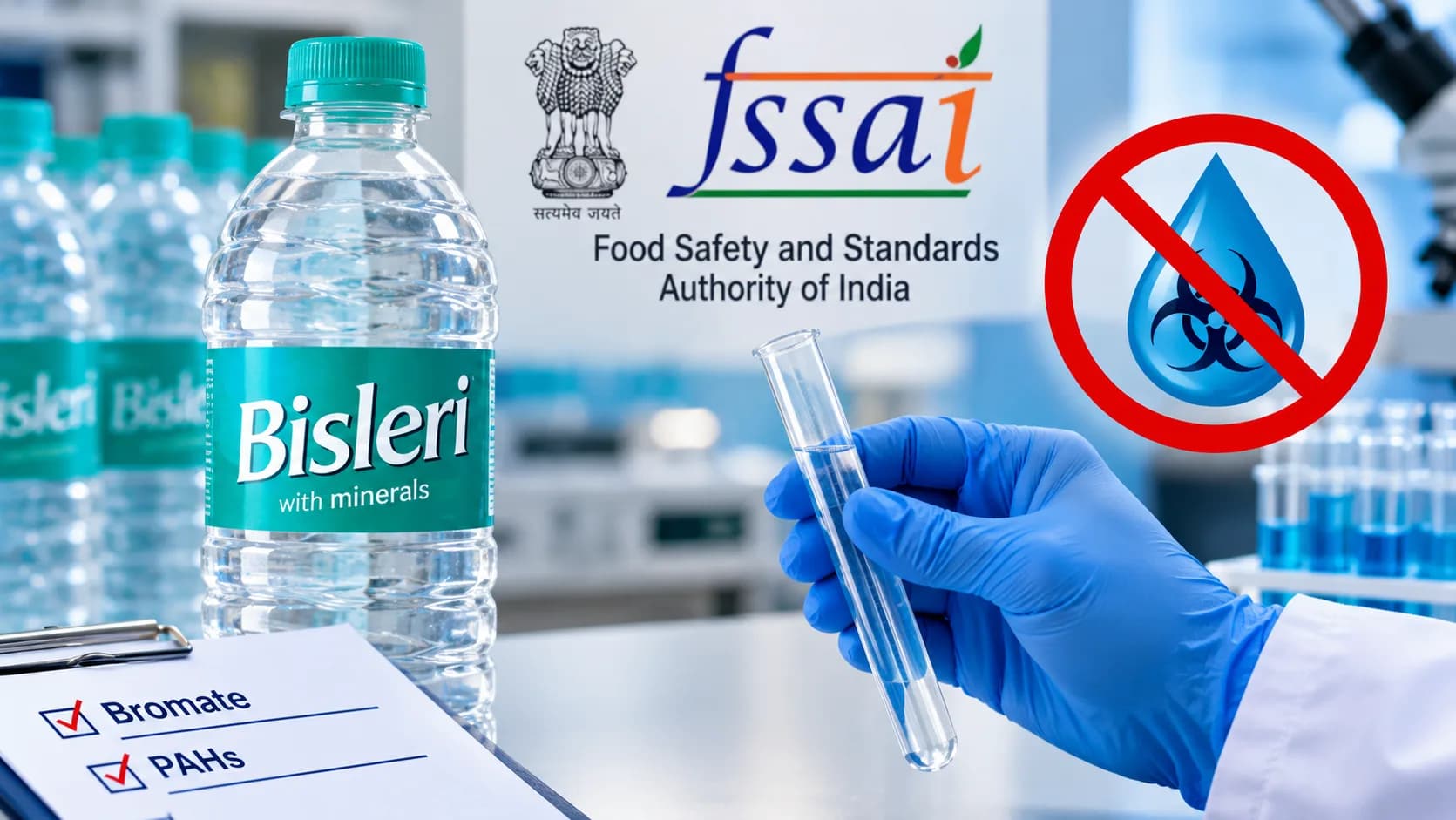
India's food safety regulator, the Food Safety and Standards Authority of India (FSSAI), has initiated prosecution proceedings against Bisleri International after a packaged drinking water sample was declared unsafe during laboratory testing.
The development has prompted wider scrutiny of India's bottled water industry, with the regulator planning inspections and sample testing across major packaged drinking water brands.
Why Was the Sample Declared Unsafe?
According to FSSAI, a regulatory sample collected from Bisleri's premises initially failed to meet the prescribed limits for bromate, a chemical that can form during certain water disinfection processes.
Following an appeal by the company, the sample was examined by a referral laboratory, which also declared it unsafe after detecting polynuclear aromatic hydrocarbons (PAHs).
Both findings raised food safety concerns, leading FSSAI to sanction prosecution under the Food Safety and Standards Act, 2006.
Bisleri Responds to the Allegations
Bisleri International has maintained that its drinking water is safe for consumption and said it would cooperate with the regulator.
The company stated that the matter relates to a batch produced at its Goa facility in September 2025. According to Bisleri, only one of six samples initially showed bromate levels above the prescribed limit.
The company also said independent testing at an FSSAI-approved laboratory found bromate within permissible limits. It highlighted its quality-control process, which includes more than 90 tests across 10 manufacturing stages.
FSSAI Expands Checks Across the Industry
Following the findings, FSSAI has widened its inspection drive to include other packaged drinking water companies.
Samples from major brands are being collected for laboratory testing. Authorities have indicated that legal action will follow if companies are found violating food safety standards.
A government source also told Reuters that batches linked to the disputed Bisleri sample had been recalled and subsequent testing found no water-quality issues.
What Should Consumers Know?
The regulatory action concerns a specific packaged drinking water sample and should not be interpreted as proof that every Bisleri product or every bottled water brand is unsafe.
Consumers should purchase sealed bottles from reliable retailers, check packaging and expiry details, and avoid products with damaged or tampered seals.
The case highlights the importance of regular testing, transparent quality controls and strict enforcement of drinking water safety standards in India.
Published: Tuesday, 24 November 2026 | 5:28 AM IST